Sunday, December 9, 2012

Television and Antiquities


This week I took a different approach, and wanted to explore antiquities as shown on popular television shows. If you were to flip through the channels on your T.V, I bet you would see many shows about people uncovering antiquities, and buying, selling or appraising them. Two popular shows that use this premise are “American Pickers”, and “Pawn Stars.” They each may have different formats, but they all deal with handling rather old objects.

 “American Pickers”, for example, is shown on the History Channel, involves two men out on the search for special antiques right in the backyard of America. Their intro reads;
“I'm Mike Wolfe. And I'm Frank Fritz. And we're pickers. We travel the back roads of America looking for rusty gold. We're looking for amazing things buried in people's garages and barns. What most people see as junk, we see as dollar signs. We'll buy "anything" we think we can make a buck on. Each item we pick has a history all its own and the people we meet? Well, they're a breed all their own. We make a living telling the history of America...one piece at a time
Wolfe and Fritz barter the items off the owners, who are most of the time hesitant, and then sell them at auction or by other means at a higher price. Wolfe and Fritz are often entertaining and likeable guys. When I watch the show, however, I often feel bad at the fact that the usually dupe the owners of the “antiquity” to buy the items at a lower price. Even after they do that, they sell the items so they can make money off of them. Even though they say they buy junk, most of the items they find are worth quite a few dollars. Once they sell the items, who knows what happens to them.

                History Channel’s “Pawn Stars” is about a 24-hour family owned pawn shop in Las Vegas. The business is operated by the often grumpy Richard "Old Man" Harrison, and his son Rick Harrison. They opened the shop in 1988. The business is always run by Rick’s son, Corey, and his clumsy friend Austin "Chumlee" Russell. They show has attracted the network’s most viewers, becoming a great success.  The pawn shop comes into contact with many interesting antiquities, such as Civil War paraphernalia or old letters from presidents. Part of the show is to determine if the object is authentic, and if it is, the owner is given the option to with pawn or sell it. The price offered to the owner is often much lower than what the appraiser says it is worth. Of course, the “Pawn Stars” buy it at a lower price to make a profit of it. The item than goes to sale at the shop, or is kept by the “Pawn Stars”, or sold elsewhere.  While I watch this show, I always wonder how the owners get some of these objects. Many times, they say it was passed down through their family, but why would they want to sell it knowing it could end up anywhere?
                These shows prove that the antiquities market is a sticky market. The objects are often bartered as if it was a gambling game. These objects are than sold or auctioned as if they were trading cards, too. One could easily see how illusive the market is. You can buy an item for $50, than sell it at auction, and make $500, even if it is not worth that much. One could say “One man’s trash is another man’s treasure”, but are these objects really trash?  If everything is worth something, than nothing is really trash, besides trash itself. Also, what if the owner wants their object back if it was stolen from them? This then leads to a case of repatriation too. It goes to show that museums are not the only places that feel the heat of the antiquities market. Local pawn shops and auction houses can be home of the shady hand of the black market. The creepy thing is, is that things like that are broadcasted on T.V for your enjoyment.  
           Even though the points I stated above may exist, "Pawn Stars" and "American Pickers" are not as evil as I may have described. My Professor brought up a good point that these shows do save objects from rotting away in a shed or barn. Many times, they restore the objects and give them a second life, so to speak. These shows also raise the public's awareness to antiquities, and perhaps could inspire people to respect antiquities more.  In the end, both shows are highly entertaining and endearing, and have a lot of value educationally as well. 


Kiera Lanni

Friday, December 7, 2012

The Reacquiring of Ancient Cambodian Artifacts and the Ethics behind it


The Reacquiring of Ancient Cambodian Artifacts and the Ethics behind it
 
     More often than not, when you go about buying something off eBay things can get kind of sketchy, however in this case the findings were a little more than sketchy. Southeast Asian archeologist Damien Huffer was sent a catalog in 2010 of ancient Cambodian artifacts, each priced at a few thousand dollars and some still containing human remains. The fact that these artifacts appeared to be just plucked off of skeletons makes it obvious that they were looted. Huffer, being a man of science, proceeded to break the news on his blog on what he had found. From here he was then contacted by members of the Cultural Property division of the Department of Environment, Water, Heritage, and the Arts. Together, they brought down the seller of the artifacts. They were then sent back to Cambodia where Huffer and his colleagues viewed the ceremony.
     Though the pieces are all back and comfortable in their native land, one can not go without asking themselves were these pieces looted in vain of their true owners, the ancient Cambodians? These artifacts were taken off of ancient corpses making them pieces of a bigger puzzle so to speak. The rest of the remains these belong to will never be found, making it a priceless loss. 
     I personally believe that it is very sad and even shocking that people would go to the extent to essentially grave rob an entire ancient culture all for the sake of money. Tell me your opinion on this in the comments section.

-Ben Hall

http://www.savingantiquities.org/bringing-them-home-the-repatriation-of-priceless-human-remains-and-artifacts-to-cambodia/ 

Thursday, December 6, 2012

Iraqi-Jewish Heritage


Conflicts between Iraq and Israel before and during World War II did not only affect the Jewish people who lived in Israel, but also effected Iraqi citizens who were Jewish. Iraq’s Anti-Semitic Legislation, created in 1933, gave the Jewish citizens a very tight leash during the beginning of the war and started to persecute them due to the conflicts between them and Israel. During the 1950’s, Iraqi secret police were ordered to raid homes in the Jewish communities, mostly in Baghdad, to search for any evidence of Zionist sentiments, which were artifacts supporting the development of Israel. In this specific case, we will look at personal items found in one home which had very little value,  but is now is the topic of Iraq’s ministry of Culture and Antiquities .

The items that are being so widely discussed consists of early Torah’s, children’s learning material, family photos and a few other personal belongings. The Iraqi Ministry of Culture and Antiquities had sent them to the United States to take care of them. They had made an agreement in 2003 that America would restore the artifacts and return them in 2005. The problem is that it is now 2012 and the artifacts are not back in the hands of Iraq. Liwaa Saisim, Iraqi Tourism and Archeology Minister has even gone as far as not letting archeological explorations continue by the United States in Iraq until the artifacts are back in Iraq.

So the question here is, why hasn’t the United States given back these pieces of Iraqi history? And another big question is why is Iraq so interested in repatriating these objects? The United States has been doing research on these items that will ultimately cost up to six million dollars, and they want to do the most that they can and complete their studies, although the U.S. acknowledges that Iraq has the right to make their claims. As for Iraq, they want the items back not for monetary value, but for the sake of informing their citizens. Saad Eskander, the director of the Iraq National Library of Archives, makes a great point when he says, “Iraqis must know that we are a diverse people, with different traditions, different religions, and we need to accept this diversity…To show it to our people that Baghdad was always multi-ethnic.”

Ultimately, I feel that that Iraq should have the artifacts back. Not only because there are legal documents that state the claim of the artifacts, but also for the sake of Iraqi people today. Saad Eskander’s statement applies to the way of living in Iraq today, because history still effects the present day and Iraqi people need to see that diversity was okay in their past and should be okay in their present day lives. It is possible to co-exist, but the public needs proof that it has happened, it can happen, and it will happen.

So you all know my stance on the issue, now what do you all think; Who do these artifacts belong to? Please respond in the comment box bellow!
-Rachel Armus

Thursday, November 29, 2012

Could Repatriation be Dangerous?


An article in The New York Times called “Seeking Return of Art, Turkey Jolts Museums” brought to my attention that repatriation cases could turn ugly. In September of 2012, Turkey had an aggressive campaign to reclaim “looted” antiquities. They have, in turn, received an ancient sphinx and other treasures from their history.  Recently, Turkish officials have filed a criminal complaint to investigate the illegal excavation of 18 antiquities that are now in the Metropolitan Museum of Art. Turkey’s director-general of cultural heritage and museums, Murat Suslu, told Met officials to “prove the provenance of ancient figurines and golden bowls in the collection, or Turkey could halt lending treasures.” This has now taken effect.  The Met calls it cultural blackmail, but Suslu is adamant that the objects belong to Turkey.

                This has caused a debate because Turkey has shifted borders for centuries, so it is not certain the objects belong to them. Museums are using the Unesco convention to keep items that were acquired before 1970. Turkey is citing a 1960 Ottoman-era law, which bans the export of antiquites, to claim any object after that date, although the ratified the Unesco convention in 1981. Turkey is also refusing to lend treasures, delaying archaeological excavation licensing, and putting down museums publicly.


                Turkey has had their fair share of repatriation success, which could be due to their agrressive ways. Hermann Parzinger, president of the Prussian Cultural Heritage Foundation has said;

“The Turks are engaging in polemics and nasty politics. They should be careful about making moral claims when their museums are full of looted treasures”

                The Turkish officials still are harping on the Met, while the Met is trying to hold onto the objects. The Turkish say stealing is wrong, and apparently will do anything to get their antiquities back. This article made me realize how controversial and important the issue of repatriation is. It could be a lot worse than this case, too.
By Kiera Lanni
Source
http://www.nytimes.com/2012/10/01/arts/design/turkeys-efforts-to-repatriate-art-alarm-museums.html?pagewanted=all

A Case of Repatriation and Native Americans


I recently stumbled upon a website entitled SAFE; Saving Antiquities for Everyone.  http://www.savingantiquities.org/tag/repatriation/ Their goal is to "raise public awareness about the irreversible damage to the study of history and culture that results from looting, smuggling, and trading illicit antiquities." Visitors are encouraged to donate to their cause, and are given tips on how to help items return to their homes. SAFE posts many stories and cases of repatriation. One that was interesting to me was entitled, the right to rest in peace: Native American human remains and NAGPRA final rule.

Native Americans have had a problem with the repatriation of unidentifiable remains. Some people believe it belongs to all humans, and not just Native Americans. Separately, it has been over twenty years since the Native American Graves Protection and Repatriation Act has become a law. It still causes debates between Native Americans, cultural institutions, and academics, however. On December 12th 2010, a contributor to the New York Times, Robert R. Kelly, wrote an article about the final rule the U.S Department of Interior made on March 15 2010, concerning the disposition of Native American culturally unidentifiable human remains. Kelly is quoted with saying that the final rule will “destroy a crucial source of knowledge about North American history and halt a dialogue between scientists and Indian tribes that has been harmonious and enlightening”.
The final rule states that “if there is no request from an Indian tribe regarding culturally unidentifiable human remains, a museum or federal agency must initiate consultation with officials and traditional religious leaders of all Indian tribes from whose tribal land or aboriginal land the human remains were removed. The consultation may include Indian groups that are not-federally recognized, but are known to have a shared group identity with the human remains at issue, at discretion of the museum or federal agency.”

                Concerning the types of remains, the NAGPRA defines two of them, which are “culturally affiliated” and “culturally unidentifiable.”  Culturally affiliated remains can be link historically to a present day Native American tribe. They are repatriated to the tribe, and then laid to rest. Culturally unidentifiable are those with no lineal descendent.  Out of respect for the Native Americans, the DOI invited public comments on the issue of how to deal with unidentifiable remains correctly.

They came up with these priorities to determine repatriation

“1. Indian tribes from whose tribal land, at the time of excavation, the remains were removed;

2. Indian tribe or tribe’s aboriginal to the area from which the remains were removed;

3. Other Indian tribe who accept to take care of the disposition of the remains;

4. Not a federally recognized tribe.”

If these cases do apply to the situation, the museum or federal agency may reinter the human remains according to State or other law, however all Native Americans involved in the consultation have agreed with the final disposition.

                Native Americans have a shared history, which they feel makes them equal. This makes the case of repatriation difficult because of the interpretation of cultural heritage. The Native Americans also feel they have the right to claim their own cultural objects since it was their land, but others argue that it belongs to the United States.  Obviously, the case of repatriation even exists here in America. Any culture could have a case regarding the subject, and still, there is no clear answer to this sticky situation.
by Kiera Lanni

Sources
http://www.savingantiquities.org/tag/repatriation/

The Case of Katana's Missing Viango Statues

Kigango statues, carved and praised by the Mijikenda people of Kenya, hold much significance to it's people. They are carved to honor deceased relatives and loved ones. In this one specific case, an elderly man named Katana carved two Viango (plural for Kiango) statues representing his two recently deceased brothers. These statues were held at the Gohu Society, which was a fraternal club that the brothers partaked in together. In 1985, Monica Udvardy, a cultural anthropologist went to visit Katana to learn about the Gohu Society and saw Katana with his newly carved statues. But shortly after her visit, the statues went missing.Udvardy heard of this horrible crime and made it her duty to find the viango and return them to Katana. it took her 15 years, but eventually she found them both. One of them belonging to the Illinois State University Museum, and the other in the Hampton University Museum in Virginia.
It is not uncommon for art dealers to perceive these artifacts as art, but really they are part of the Mijikenda people's culture and are part of their rituals. If they are stolen, the spirits would inflict harm on their living family members. These viango were not to be taken as a joke or just a beauty, but they are part of  lifestyle.

This is an example of a looting case that is not from a natural historic site, but from someone's own personal property. This also shows that looting really can harm many people. I think that Looters need to learn their boundaries. Although it is wrong to loot anywhere at all, it gets very personal when you are taking something from a specific person and treating it as a cultural artifact and selling it on the markets. I want to hear from all of you, does it make it any different for artifacts to be stolen from one specific person, does it even make it robbing rather than looting? Write your responses bellow!

http://www.culturalsurvival.org/publications/cultural-survival-quarterly/kenya/cultural-property-global-commodities-case-mijikenda-m

Posted by Rachel Armus

Friday, November 23, 2012

Edward George Johnson: The One man Heist


Edward George Johnson: The One man Heist
By, Ben Hall
     In February of 2002, helicopter pilot Edward George Johnson was sent into Cairo with the American military for an eight month tour ending in October of the same year. He was tasked to transport troops and scout areas to dangerous to trek on foot. He served the full eight months and the end of 2002 and beginning of 2003, Johnson had ended up walking away with $20,000. Sounds pretty nice for being a helicopter pilot for only 8 months in Egypt right? Well it turns out that this considerable amount of money was not made from Johnson’s excellent piloting skills, but rather from his skills as a looter.   


Some Artifacts taken by Johnson, Photographed by Amged Maky

 Johnson had stolen some 80 artifacts from Egypt over  the course of his military tour. This first came to the public’s eye when Johnson had contacted a dealer who had been working with the government.  It is reported that the artifacts, before falling into Johnsons hands, where help in the Ma’adi Museum. Initially, looting from dig sites is a crime large enough for one to go to jail, and a disgraceful heinous act, but Johnson looted an actual museum, which in my opinion is 10x worse. It would be the equivalent of an Egyptian coming into the Museum of Natural history in New York during a time of chaos, and taking artifacts that rightfully belong to it. Essentially Johnson took advantage of the situation in a time where it was completely unnecessary.

     
Outside of the Ma’adi in Cairo

     Johnson, in this situation, is the only one to blame. There were no accomplices reported assisting Johnson when stealing and shipping the artifacts. It was his idea alone, and only he alone executed it. Not even the Ma’adi is to blame, as it is not their fault. Sure, security should have been beefed up, but during such a time of crisis and confusion anything can happen because most of the time people are vulnerable. Johnson took advantage of not just a museum, but an entire culture.

Comment if you agree with my opinion on Johnson being the only one that should be held accountable for this crime.  
Works Cited
"Blogger." : Create Your Free Blog. N.p., n.d. Web. 23 Nov. 2012. <http://www.blogger.com/blogger.g?blogID=3173095721550120408>.
Feuer, Alan. "Army Pilot Held in Sale of Egyptian Artifacts." The New York Times. The New York Times, 07 Feb. 2008. Web. 23 Nov. 2012. <http://www.nytimes.com/2008/02/07/nyregion/07soldier.html>.
"News Releases." ICE Returns Stolen Antiquities to Egypt. N.p., n.d. Web. 23 Nov. 2012. <http://www.ice.gov/news/releases/0812/081203newyork.htm>. 

Our Own United States Helicopter Pilot Charged with 80 Accounts

Our Own United States Helicopter Pilot Charged with 80 Accounts

By Rachel Armus
 
Edward George Johnson, a Chief Warrant Officer and helicopter pilot for the U.S. Army was convicted and charged with selling stolen antiquites from Egypt. He sold over 80 artifacts to an art dealer in Texas, and were resold to art gallories in New York. The artifacts that he found were mostly pottery dating all the way back to 300 BC and are said to be stolen form the Ma’adi Museum near Cairo. Although they were stolen in 2002, the artifacts were discovered earlier by archeologists in the 1920’s. Johnson was charged with wire frauda nd transportation of stolen property, and can face up to 15 years in prison for it.

I believe that Johnson is guilty for a few reason. One reason being that these artifacts were discovered in a meuseum in Cairo, showing that they rightfully were in Egypt as it is. Johnsons actions were more stealing than looting because looting is taking something out of their natural environment, and in this instance they were stolen from a rightful owner. Also, Johnson did not have any real documentation to show the art dealer in Texas that these artifacts were obtained legally.

Another person that should be charged for these accounts is the art dealer in Texas. He should have asked for legal documentation that showed the artifacts were infact his.

I also believe that the Ma’adi Museum should be held accountable for looting because these artifacts were taken from their natural environments. If the New York gallories are getting these artifacts illegally, wouldn’t it be illegal for the Ma’adi Museam to have them illegally too. It is hard to tell whether any artifacts were obtained legally, so who knows if the other gallory had them legally in the first place considering all of the flaws in the system of antiquity trades.

Comment below and tell us, do you feel that Johnson is the only one that did wrong here? Or do you think that the Museum in Cairo, the dealer in texas and the New york Gallories should be held accountable as well?
 
Sources:

Tuesday, November 13, 2012

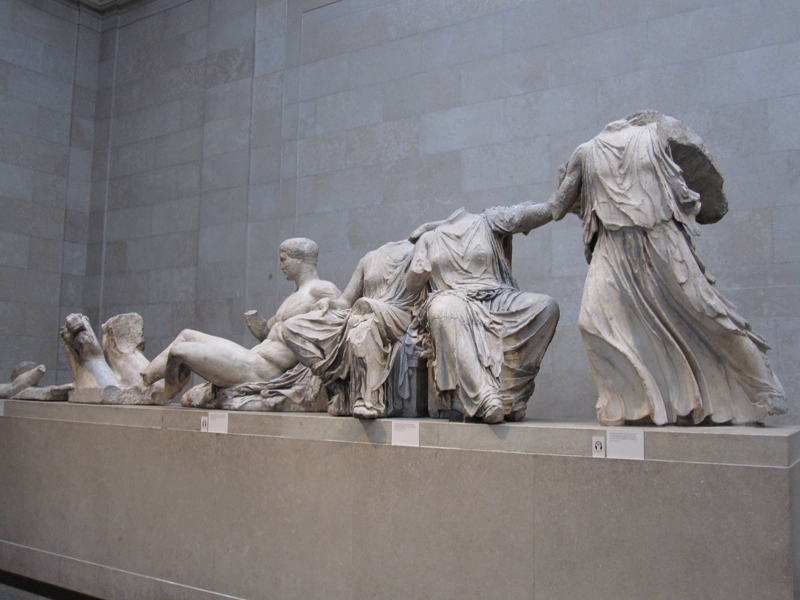
The Elgin Marbles, or the Parthenon Marbles? Greece's Argument


            Britain had made quite the claim regarding why they should keep the Parthenon marbles. Overall, they want the marbles because they feel it had been in their possession long enough that they should keep it. Of course, Greece is not at all happy about that. Reflecting back on Morag Kersel’s article, “The Politics of Playing Fair, or, Who’s Losing Their Marbles?” , Kersel offered many legitimate reasons why Greece wants the marbles;

  1. First, “The monument to which the sculptures belong is in Athens (Hellenic Ministry of Culture 2002).”
  2. Second, “in Athens the Marbles will be exhibited within sight of the Parthenon, and the visitor can form a complete image of the temple in its entirety (Prunty 1984. I 178).”
  3. Third, “the cultural and historical significance of the sculptures as well as their aesthetic importance to Greece act as symbols of national heritage-the symbol of Greek Classical civilization at its apogee.”
  4. Lastly, “the Marbles were removed during a period of foreign occupation when the Greek people had no say in the matter (Greenfield 1996. 83).
  5. “The Marbles were wrongly taken by Lord Elgin and have never legally or morally belonged to him or Britain (Merryman 1985, 1897)” (Kersel 48).
    http://action.hellenicleaders.com/p/dia/action3/common/public/?action_KEY=7659 (a website asking for the marbles back, pretty interesting!)

Greece, as they should, feels the marbles are rightfully theirs. In came from their land, and was basically stolen from them by Lord Elgin. Greece, at the time, was under control of the Ottoman Empire, therefore they did not really have a true say in the matter. The means by which Britain obtained the marbles is sketchy, and Britain even knows that.

      The marbles are a symbol of democracy and of the Classical era of Greece. They want the marbles back in the Pantheon to, perhaps, show the world how proud they are of their culture, and to display the marbles in their own home to offer more meaning to the marbles.  Furthermore, Greece is capable of taking as well as care of the marbles as Britain is. Also, regarding Britain’s thought that the marbles have become their history too; the marbles are a symbol of Greece, made in Greece, and have nothing to do with Britain. They are essentially in the museum illegally if one was to think about it: they were stolen after all. Greece is simply asking for a part of their culture back, which they ultimately deserve.

      In Conclusion, both sides offer compelling reasons as to why they should own the marbles. It is a tricky situation. Perhaps in the future, the two countries could work out a deal. Maybe Greece could give them another artifact, or maybe the two countries could share the marbles. Britain could display them for a year, and then Greece could, over and over. My personal opinion is that I feel it is silly that two countries are fighting over the marbles. They could work something out, but then again, if Greece wanted them that bad, I feel they would make sure that they got them. On the other hand, there are many campaigns to get the marbles back to Greece, such as this one; http://www.cyprusnewsreport.com/?q=node/5436. The situation is like a ping pong match going nowhere. Hopefully a deal will come out of this one day.

Thursday, October 25, 2012

The Portrait of Wally


The Portrait of Wally
By Ben Hall
     Background
Painted in 1912 by Austrian painter Egon Schiele, The Portrait of Wally perfectly exemplifies the controversial struggles of nations attempting to regain a piece of their heritage. Initially it was sold pre-World War II to art collector Lea Bondi, who did not know at the time that this piece of artwork would set off a chain of events as controversial as it was. The portrait was passed around several times after leaving Bondi's hands and ultimately ended up in the Leopold Meusum of modern art in Austria.


File:Leopold Museum (Vienna).jpg
Picture outside of the Leopold

Controversy
The Leopold then, in 1997, had loaned its Schiele collection to the Museum of Modern Art in New York City. Soon after being alerted by an art dealer, a reporter for The New York Times reported the painting as being stolen Nazi loot. After the article was published, the heirs of Bondi demanded that the painting would not return to the Leopold and be returned to the Bondi family.

 Resolution
A little over ten years later, the Bondis and the Leopold had reached an agreement; the Leopold would give the Bondi family a $19 million dollar settlement in July of 2010 for their “stolen nazi loot”.

The entire story behind the portrait has even inspired a documentary which tells the entire struggle. Link to the Trailer:
Works Cited:
"The Art Newspaper." What Makes the Portrait of Wally Case so Significant? -. N.p., n.d. Web. 22 Oct. 2012. <http://www.theartnewspaper.com/articles/What-makes-the-Portrait-of-Wally-case-so-significant/26309>.
"Telling the Story of Portrait of Wally." Telling the Story of Portrait of Wally. N.p., n.d. Web. 25 Oct. 2012. <http://artbusinessnews.com/2012/05/portrait-of-wally-egon-schiele-andrew-shea/>.


Tuesday, October 23, 2012

The Elgin Marbles, or the Parthenon Marbles? Britain's Arguement


                Recently in our class, The Ancient World in Contemporary Imagination, we discussed the situation of Greek’s Parthenon marbles.  To help our understanding, we read an article by Morag Kersel called article “The Politics of Playing Fair, Who’s Losing Their Marbles?” To understand the issue, we have to see how the marbles ended up in the British Museum. After defeating the Persians in 479 B.C, the Athenians wanted to rebuild their city of Athens to make it an important cultural, political, and artistic center. They created the Parthenon and the temple of the Maiden, where the marbles came from, between 447 and 438 B.C. (Kersel 42-43). The Parthenon did however suffer throughout wars and earthquakes, becoming less significant as time went on. Fast forwarding to the 17th and 18th centuries, Europe was experiencing an era of Classicism. Europe became very interesting in classical monuments from ancient Greece and Rome. In 1795, Lord Elgin, who was a diplomat posted to Constantinople in the Ottoman Empire, went on a search for classical inspiration. Inspired by an architect, Elgin went to the marbles of the Acroplolis. He asked permission from Sultan Selim III, and said he wanted to just sketch and look at the architectural elements. It is not known whether the firman gave him full permission, but Elgin went home with the marbles. With some hesitation due to the illegal nature of how Elgin obtained the marbles, the British government bought the marbles for a cheap price. They were put in the British museum, where they now reside (Kersel 46).


           Greece, for centuries, never said they wanted the marbles back until recently.  Greece had been under Ottoman control during the time of the obtaining of the marbles, but had gained independence in 1828. Why did they not ask for the marbles then? Britain believes that Greece wanted the marbles to bring tourism to their country, and turn it into a sort of “theme park” Would Greece take any better care of the marbles then Britain already does? Britain feels as if it would make no sense to move an item from one museum to the other, and Kersel says that Greece has no plans to restore the marbles to the Parthenon.  People who support Britain’s argument believe that the marbles will simply waste away ( Kersel 50). In Kersel’s article, he provided four points as to why Britain should keep the marbles. They are the following;

  1. “First, the Marbles were removed legitimately on the basis of a legal document-the Sultan's firman.”
  2. “Second, returning the Marbles to Greece would constitute a precedent for the universal removal of major acquisitions of the world's museums, thus limiting the role of the museum in the education of the populace (Trade Environmental Database 2002).”
  3. “Third, the removals were necessary on conservation grounds, and they have proved highly beneficial in preserving the sculptures from 150 years of high levels of pollution in Athens.”
  4. “Fourth, the Marbles have become an integral part of the British cultural heritage (Reppas

1999, 917)” (Kersel 48).

Britain feels as though they have the marbles for the better of the people; to educate them about Greece for free. They feel the removal of the marbles was justified and that Elgin did have permission. They also feel that the marbles are not threatened and they do a great job of looking after the marbles. The fact that the marbles are in the British Museum has made the marbles more significant than they would have been if they were not placed there. Kersel wrote that their place in the museum “contributed to the worldwide recognition of the greatness Greece in the age before globalization” (Kersel 53). It shows that Greece’s influence can be found more than just in Greece, and that their great art is something worth sharing.

                In conclusion, Britain does not want to give up the marbles. They feel that the marbles have been in their museum so long that it has become theirs. The question of heritage comes in again, and we find ourselves asking, “Do the marbles really belong to anybody?” As humans, we all share common heritage, therefore, should we all be entitled to feel as though the marbles belong to us too? For now, though, the marbles will remain in Britain, available for all to see with the help of a flight to Britain.
                                                                  British Museum
Written by Kiera Lanni

Works Cited


Kersel, M. (2004). The Politics of Playing Fair, or, Who's Losing Their Marbles? In U. B. YORKE ROWAN, MARKETING HERITAGE: Archaeology and the Consumption of the Past (p. 331). Walnut Creek, Lanham, Oxford: Altamira Press.

Monday, October 15, 2012

Our Mission and Goal


Our Mission and Goal

On our blog, we will further be talking about various trials of stolen antiquities that are directly related to repatriation. Within these cases, we will discuss the importance of heritage and answer questions such as “Do these items now belong to the new founders of them, or do they belong rightfully to the place of origin?” This question is very controversial and sparks curiosity within us, and hopefully you too. Some of the cases we will be discussing are “The Portrait of Wally”, “Peruvian Sculls”, “Egyptian Sarcophagus” and many more. So I would like to hear from you, should we go by “finders keepers, losers weepers”? Or, are the items rightfully owned by their original founders?

http://www.ice.gov/news/library/factsheets/cultural-artifacts.htm

Sunday, October 14, 2012

Introduction to Repatriation and Global Heritage


Imagine this; a group of archaeologists have just discovered an amazing new artifact in a temple in Mexico. They are floored to discover such a rare piece of history, and cannot wait to bring it to their university in the United States to study and restore it. Imagine all the secrets and answers in can hold! Do these archaeologists, however, have the right to take this item as their own and study it? Or does it belong to the government of Mexico? This is the question that has hung over the field of archaeology since it began. 
 Repatriation of artifacts is a subject of much controversy. From an article, Who’s Right? Repatriation of Cultural Property by Malcolm Bell III,The Oxford English Dictionary defines “repatriate” as “to restore (an artifact or other object) to its country or place of origin,” and recognizes repatriation as a process of restoration, of making whole again”. Organizations such as UNESCO have worked in protecting and restituting cultural property. The Global Heritage Fund works to protect endangered and important cultural sites and their treasures. These organizations and other government programs work to end the stealing of antiquities, undocumented excavating, and preserving culture. 
 Many believe that an artifact should stay in its place to protect the culture of a community. Do these artifacts, though, really belong to them? As said in the article, World Heritage Rights Versus National Cultural Property Rights: The Case of the Jikji by Sun-Young Kwak, “Is cultural property the universal common heritage of mankind or do specific communities or nations have proprietary rights to their own cultural property?” It is hard to say who really exactly owns these artifacts, which is why the other side of this issue argues that one should take these artifacts for study and show off in museums for all to see rather than being “unsafely kept” where it was found.  Again from the article, Who’s Right? Repatriation of Cultural, the author Malcolm Bell III brings up the issue of “moral” rights.  Some of the rights he stated were;
“• The right to continued existence
• The right to proper conservation.
• The right to the preservation of relevant historical or archaeological documentation.
• The right to public access.
• The right to consolidation when a work exists in fragments.”\
            These issues, and more, will be discussed on this blog. This blog will look into some trials and artifacts that are subject to controversy due to repatriation and global heritage.  Each week, we will look at each side of the argument; why the government or people of where the object was found want it, and why the people who found it or museums want it. As the weeks go on, we hope to gain a better understanding of the issues surrounding excavations, as well as truly reflecting on “who owns the past”. As a side note, this a blog for a college class and the information presented is not written by professionals, just students.
            To learn more about Unesco and The Global Heritage funds, click the links below.
By Kiera Lanni

Bibliography

Bergman, Eric. "Reversing the Flow of Traffic in the Market of Cultural Property." n.d. Abya Yala News Online . October 2012 <http://saiic.nativeweb.org/ayn/repat.html>.
Kwak, Sun-Young. "World Heritage Rights Versus National Cultural Property Rights: The Case of the Jikji." 22 April 2005. Carnegie Council . October 2012 <http://www.carnegiecouncil.org/publications/archive/dialogue/2_12/online_exclusive/5153.html>.
Malcolm Bell III, James Cuno. "Who’s Right? Repatriation of Cultural Property." 2 November 2010. IIP Digital . October 2012 <http://iipdigital.usembassy.gov/st/english/publication/2010/10/20101022140412aidan0.7519953.html#axzz297GmMHqL>.