 Recently
in our class, The Ancient World in Contemporary Imagination, we discussed the
situation of Greek’s Parthenon marbles. To help our understanding, we read an article
by Morag Kersel called article “The Politics of Playing Fair, Who’s Losing
Their Marbles?” To understand the issue, we have to see how the marbles ended
up in the British Museum. After defeating the Persians in 479 B.C, the
Athenians wanted to rebuild their city of Athens to make it an important
cultural, political, and artistic center. They created the Parthenon and the
temple of the Maiden, where the marbles came from, between 447 and 438 B.C. (Kersel
42-43). The Parthenon did however suffer throughout wars and earthquakes,
becoming less significant as time went on. Fast forwarding to the 17th
and 18th centuries, Europe was experiencing an era of Classicism. Europe became
very interesting in classical monuments from ancient Greece and Rome. In 1795,
Lord Elgin, who was a diplomat posted to Constantinople in the Ottoman Empire,
went on a search for classical inspiration. Inspired by an architect, Elgin
went to the marbles of the Acroplolis. He asked permission from Sultan Selim
III, and said he wanted to just sketch and look at the architectural elements.
It is not known whether the firman gave him full permission, but Elgin went
home with the marbles. With some hesitation due to the illegal nature of how
Elgin obtained the marbles, the British government bought the marbles for a
cheap price. They were put in the British museum, where they now reside (Kersel
46).
Recently
in our class, The Ancient World in Contemporary Imagination, we discussed the
situation of Greek’s Parthenon marbles. To help our understanding, we read an article
by Morag Kersel called article “The Politics of Playing Fair, Who’s Losing
Their Marbles?” To understand the issue, we have to see how the marbles ended
up in the British Museum. After defeating the Persians in 479 B.C, the
Athenians wanted to rebuild their city of Athens to make it an important
cultural, political, and artistic center. They created the Parthenon and the
temple of the Maiden, where the marbles came from, between 447 and 438 B.C. (Kersel
42-43). The Parthenon did however suffer throughout wars and earthquakes,
becoming less significant as time went on. Fast forwarding to the 17th
and 18th centuries, Europe was experiencing an era of Classicism. Europe became
very interesting in classical monuments from ancient Greece and Rome. In 1795,
Lord Elgin, who was a diplomat posted to Constantinople in the Ottoman Empire,
went on a search for classical inspiration. Inspired by an architect, Elgin
went to the marbles of the Acroplolis. He asked permission from Sultan Selim
III, and said he wanted to just sketch and look at the architectural elements.
It is not known whether the firman gave him full permission, but Elgin went
home with the marbles. With some hesitation due to the illegal nature of how
Elgin obtained the marbles, the British government bought the marbles for a
cheap price. They were put in the British museum, where they now reside (Kersel
46). 

Greece, for centuries, never said they wanted the marbles back until recently. Greece had been under Ottoman control during the time of the obtaining of the marbles, but had gained independence in 1828. Why did they not ask for the marbles then? Britain believes that Greece wanted the marbles to bring tourism to their country, and turn it into a sort of “theme park” Would Greece take any better care of the marbles then Britain already does? Britain feels as if it would make no sense to move an item from one museum to the other, and Kersel says that Greece has no plans to restore the marbles to the Parthenon. People who support Britain’s argument believe that the marbles will simply waste away ( Kersel 50). In Kersel’s article, he provided four points as to why Britain should keep the marbles. They are the following;
- “First,
the Marbles were removed legitimately on the basis of a legal document-the
Sultan's firman.”
- “Second,
returning the Marbles to Greece would constitute a precedent for
the universal removal of major acquisitions of the world's museums, thus
limiting the role of the museum in the education of the populace (Trade
Environmental Database 2002).”
- “Third,
the removals were necessary on conservation grounds, and they have proved
highly beneficial in preserving the sculptures from 150 years of high
levels of pollution in Athens.”
- “Fourth,
the Marbles have become an integral part of the British cultural heritage
(Reppas
1999, 917)” (Kersel 48).
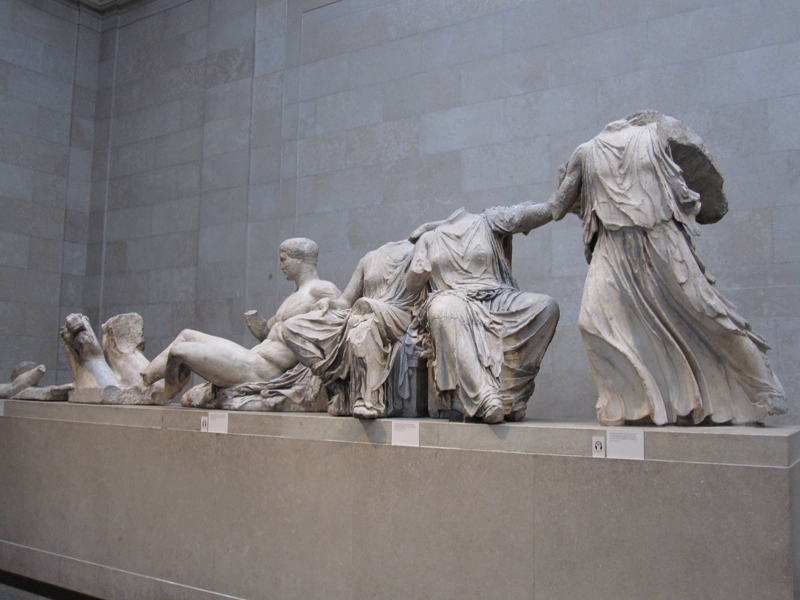
Britain feels as though they have
the marbles for the better of the people; to educate them about Greece for
free. They feel the removal of the marbles was justified and that Elgin did
have permission. They also feel that the marbles are not threatened and they do
a great job of looking after the marbles. The fact that the marbles are in the
British Museum has made the marbles more significant than they would have been
if they were not placed there. Kersel wrote that their place in the museum “contributed
to the worldwide recognition of the greatness Greece in the age before
globalization” (Kersel 53). It shows that Greece’s influence can be found more
than just in Greece, and that their great art is something worth sharing.
In
conclusion, Britain does not want to give up the marbles. They feel that the
marbles have been in their museum so long that it has become theirs. The question
of heritage comes in again, and we find ourselves asking, “Do the marbles
really belong to anybody?” As humans, we all share common heritage, therefore,
should we all be entitled to feel as though the marbles belong to us too? For
now, though, the marbles will remain in Britain, available for all to see with
the help of a flight to Britain.

Written by Kiera Lanni
Works Cited
Kersel, M. (2004). The Politics of Playing Fair, or,
Who's Losing Their Marbles? In U. B. YORKE ROWAN, MARKETING HERITAGE:
Archaeology and the Consumption of the Past (p. 331). Walnut Creek,
Lanham, Oxford: Altamira Press.

I like the picture you posted with the statue and quote "You can steal a statue but you cannot steal my origin. I am Greek". I think that it sums up Greece's opinion on this issue pretty well, since they believe they should have the marbles that originated in their country.
ReplyDelete